
Wednesday, July 30, 2008

History of watches
In the 15th century, the increase in European sea-going navigation and mapping increased the demand for a portable timepiece, because the only way a ship could measure its longitude was by comparing the midday (high noon) time of the local longitude to that of a European meridian (usually Paris or Greenwich) using the time kept on a shipboard clock. However, the process was notoriously unreliable until the introduction of John Harrison's marine chronometer. For that reason, most maps from the 15th century through the 19th century have precise latitudes but distorted longitudes.
The first reasonably accurate mechanical clocks measured time with simple weighted pendulums, which are unworkable when irregular movement of the fulcrum occur whether at sea or in watches. The invention of a spring mechanism was crucial for portable clocks. In Tudor England, the development of "pocket-clockes" was enabled by the development of reliable springs and escapement mechanisms, which allowed clockmakers to compress a timekeeping device into a small, portable compartment.
In 1524, Peter Henlein created the first pocket watch.[15] Early watches only had an hour hand—a minute hand would have been useless because of the inaccuracy of the watch mechanism. Eventually, miniaturization of these spring-based designs allowed for accurate portable timepieces (marine chronometers) which worked well even at sea. In 1556, Taqi al-Din created a spring-powered[16] pocket watch,[17] which was able to measure the time in minutes by having three dials for the hours, degrees and minutes.[16] Another early example of a watch which measured time in minutes was created by another Ottoman watchmaker, Meshur Sheyh Dede, in 1702.[18]
In 1850, Aaron Lufkin Dennison founded Waltham Watch Company, which was the pioneer of the industrial manufacturing of pocket watches with interchangeable parts, the American System of Watch Manufacturing. Breguet developed the first self-winding watch known as the perpetual in 1780.[19]
Functions
All watches provide the time of day, giving at least the hour and minute, and usually the second. Most also provide the current date, and often the day of the week as well. However, many watches also provide a great deal of information beyond the basics of time and date. Some watches include alarms. Other elaborate and more expensive watches, both pocket and wrist models, also incorporate striking mechanisms or repeater functions, so that the wearer could learn the time by the sound emanating from the watch. This announcement or striking feature is an essential characteristic of true clocks and distinguishes such watches from ordinary timepieces. This feature is available on most digital watches.
A complicated watch has one or more functions beyond the basic function of displaying the time and the date; such a functionality is called a complication. Two popular complications are the chronograph complication, which is the ability of the watch movement to function as a stopwatch, and the moonphase complication, which is a display of the lunar phase. Other more expensive complications include, Tourbillion, Perpetual calendar, Minute repeater and Equation of time. A truly complicated watch has many of these complications at once (see Calibre 89 from Patek Philippe for instance). Among watch enthusiasts, complicated watches are especially collectible. Some watches include a second 12-hour display for UTC (as Pontos Grand Guichet GMT).
Digital
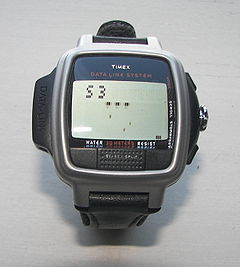
Since the advent of electronic watches that incorporate small computers, digital displays have also been available. A digital display simply shows the time as a number, e.g., 12:40 AM instead of a short hand pointing towards the number 12 and a long hand pointing towards the number 8 on a dial. Some watches, such as the Timex Datalink USB, feature dot matrix displays.
The first digital watch, a Pulsar prototype in 1970, was developed jointly by Hamilton Watch Company and Electro-Data. John Bergey, the head of Hamilton's Pulsar division, said that he was inspired to make a digital timepiece by the then-futuristic digital clock that Hamilton themselves made for the 1968 science fiction film 2001: A Space Odyssey. On April 4, 1972 the Pulsar was finally ready, made in 18-carat gold and sold for $2,100 at retail. It had a red light-emitting diode (LED) display. Another early digital watch innovator, Roger Riehl's Synchronar Mark 1, provided an LED display and used solar cells to power the internal nicad batteries.[7]
Most watches with LED displays required that the user press a button to see the time displayed for a few seconds, because LEDs used so much power that they could not be kept operating continuously. Watches with LED displays were popular for a few years, but soon the LED displays were superseded by liquid crystal displays (LCDs), which used less battery power and were much more convenient in use, with the display always visible and no need to push a button before seeing the time. The first LCD watch with a six-digit LCD was the 1973 Seiko 06LC, although various forms of early LCD watches with a four-digit display were marketed as early as 1972 including the 1972 Gruen Teletime LCD Watch, and the Cox Electronic Systems Quarza.[8][9]
Digital watches were very expensive and out of reach to the common consumer until 1975, when Texas Instruments started to mass produce LED watches inside a plastic case. These watches, which first retailed for only $20, reduced to $10 in 1976, saw Pulsar lose $6 million and the brand sold to competitors twice in only a year, eventually becoming a subsidiary of Seiko and going back to making only analogue quartz watches.
From the 1980s onward, digital watch technology vastly improved. In 1982 Seiko produced a watch with a small television screen built in, and Casio produced a digital watch with a thermometer as well as another that could translate 1,500 Japanese words into English. In 1985, Casio produced the CFX-400 scientific calculator watch. In 1987 Casio produced a watch that could dial your telephone number and Citizen revealed one that would react to your voice. In 1995 Timex release a watch which allowed the wearer to download and store data from a computer to their wrist. Since their apex during the late 1980s to mid 1990s high technology fad, digital watches have mostly devolved into a simpler, less expensive basic time piece with little variety between models.
Despite these many advances, almost all watches with digital displays are used as timekeeping watches. Expensive watches for collectors rarely have digital displays since there is little demand for them. Less craftsmanship is required to make a digital watch face and most collectors find that analog dials (especially with complications) vary in quality more than digital dials due to the details and finishing of the parts that make up the dial (thus making the differences between a cheap and expensive watch more evident).
Power sources

Traditional mechanical watch movements use a spiral spring called a mainspring as a power source. In manual watches the spring must be rewound by the user periodically by turning the watch crown. Antique pocketwatches were wound by inserting a separate key into a hole in the back of the watch and turning it. Most modern watches are designed to run 40 hours on a winding, so must be wound daily, but some run for several days and a few have 192-hour mainsprings and are wound weekly.
A self-winding or automatic mechanism is one that rewinds the mainspring of a mechanical movement by the natural motions of the wearer's body. The first self-winding mechanism, for pocketwatches, was invented in 1770 by Abraham-Louis Breguet;[4] but the first "self-winding," or "automatic," wristwatch was the invention of a British watch repairer named John Harwood in 1923. This type of watch allows for a constant winding without special action from the wearer: it works by an eccentric weight, called a winding rotor, that rotates with the movement of the wearer's wrist. The back-and-forth motion of the winding rotor couples to a ratchet to automatically wind the mainspring. Self winding watches usually can also be wound manually so they can be kept running when not worn, or if the wearer's wrist motions don't keep the watch wound.
Some electronic watches are also powered by the movement of the wearer of the watch. Kinetic powered quartz watches make use of the motion of the wearer's arm turning a rotating weight, which turns a generator to supply power to charge a rechargeable battery that runs the watch. The concept is similar to that of self-winding spring movements, except that electrical power is generated instead of mechanical spring tension.
Electronic watches require electricity as a power source. Some mechanical movements and hybrid electronic-mechanical movements also require electricity. Usually the electricity is provided by a replaceable battery. The first use of electrical power in watches was as substitute for the mainspring, in order to remove the need for winding. The first electrically-powered watch, the Hamilton Electric 500, was released in 1957 by the Hamilton Watch Company of Lancaster, Pennsylvania.
Watch batteries (strictly speaking cells) are specially designed for their purpose. They are very small and provide tiny amounts of power continuously for very long periods (several years or more). In most cases, replacing the battery requires a trip to a watch-repair shop or watch dealer; this is especially true for watches that are designed to be water-resistant, as special tools and procedures are required to ensure that the watch remains water-resistant after battery replacement. Silver-oxide and lithium batteries are popular today; mercury batteries, formerly quite common, are no longer used, for environmental reasons. Cheap batteries may be alkaline, of the same size as silver-oxide but providing shorter life. Rechargeable batteries are used in some solar powered watches.
Solar powered watches are powered by light. A photovoltaic cell on the face (dial) of the watch converts light to electricity, which in turn is used to charge a rechargeable battery or capacitor. The movement of the watch draws its power from the rechargeable battery or capacitor. As long as the watch is regularly exposed to fairly strong light (such as sunlight), it never needs battery replacement, and some models need only a few minutes of sunlight to provide weeks of energy (as in the Citizen Eco-Drive).
Some of the early solar watches of the 1970s had innovative and unique designs to accommodate the array of solar cells needed to power them (Synchronar, Nepro, Sicura and some models by Cristalonic, Alba, Seiko and Citizen). As the decades progressed and the efficiency of the solar cells increased while the power requirements of the movement and display decreased, solar watches began to be designed to look like other conventional watches.[5] A rarely used power source is the temperature difference between the wearer's arm and the surrounding environment (as applied in the Citizen Eco-Drive Thermo).
Mechanical movements

ompared to electronic movements, mechanical watches are less accurate, often with errors of seconds per day, and they are sensitive to position and temperature. As well, they are costly to produce, they require regular maintenance and adjustment, and they are more prone to failure. Nevertheless, the "old world" craftsmanship of mechanical watches still attracts interest from part of the watch-buying public.
Mechanical movements use an escapement mechanism to control and limit the unwinding of the watch, converting what would otherwise be a simple unwinding, into a controlled and periodic energy release. Mechanical movements also use a balance wheel together with the balance spring (also known as Hairspring) to control motion of the gear system of the watch in a manner analogous to the pendulum of a pendulum clock. The tourbillon, an optional part for mechanical movements, is a rotating frame for the escapement which is intended to cancel out or reduce the effects of bias to the timekeeping of gravitational origin. Due to the complexity designing a tourbillon, they are very expensive, and only found in "prestige" watches. The pin-lever, (also called Rosskopf) movement, after its inventor: Georges Frederic Roskopf, is a cheaper version of the fully levered movement which was manufactured in huge quanties by many Swiss manufacturers as well as Timex, until it was replaced by quartz movements.[1][2]
Tuning fork watches use a type of electromechanical movements. Introduced by Bulova in 1960, they use a tuning fork at a precise frequency (most often 360 hertz) to drive a mechanical watch. The task of converting electronically pulsed fork vibration into rotary movement is done via two tiny jeweled fingers, called pawls. Tuning fork watches were rendered obsolete when electronic quartz watches were developed, because quartz watches were cheaper to produce and even more accurate.
Subscribe to:
Posts (Atom)